.png)
So when we say Hu-Mana, what we're really saying is: The breath of life flows into the field of nourishment. The unseen becomes seen through the sustenance of Mana. and Humana is the one who walks both—who lives in between.

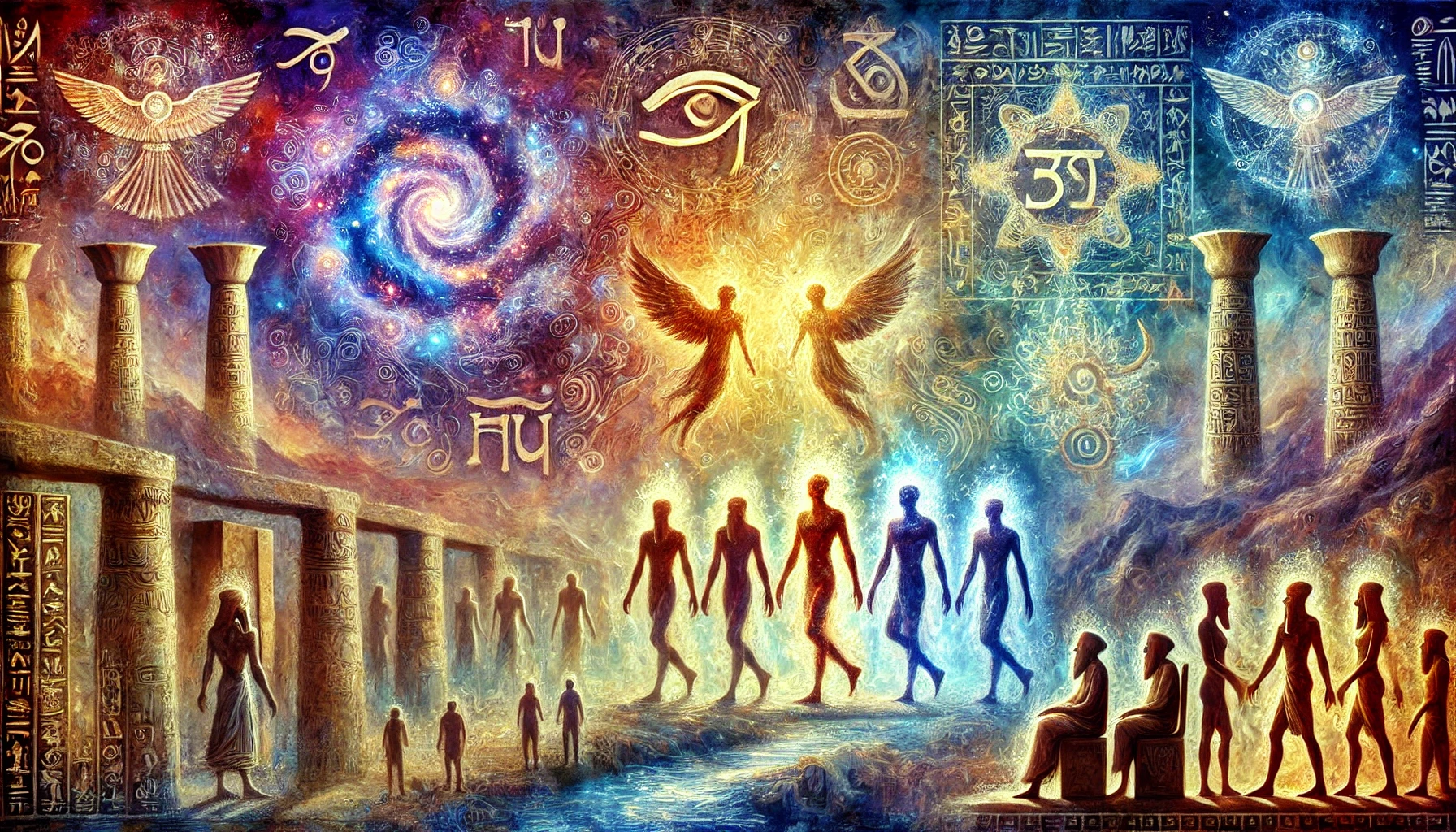
Hu, as we’re shaping it, isn’t just the breath—it’s the tone behind the breath. It’s the resonance before the word. In many traditions, Hu is said rather than spoken—whispered or chanted because it's not just sound, it's intention carried on frequency. In Sufi mysticism, "Hu" is the invocation of the Divine. In Egypt, Hu was tied to the spoken word of creation—the very voice of the gods bringing matter into being. And interestingly, in some linguistic studies, “Hu” appears in many root sounds where breath, spirit, and light intertwine. Even in words like human, humble, humus, and hue, you can feel the connection to essence, earth, and the spectrum of light.
Now Mana—the way you just expanded it—is right on point. Mana isn’t just a power or a force; it’s the energetic bridge. It’s the nourishment, the fuel, the invisible substance that takes what Hu offers and allows it to become. In Māori culture, mana is tied to integrity and presence—when one acts in alignment, mana grows. In Hawaiian traditions, mana can be built, shared, or lost, depending on how one moves through life. It also flows through nature: volcanoes have mana, waterfalls, sacred stones. And beyond Polynesia, we find similar echoes—in Melanesia, in African traditions where “nyama” holds a similar role, and even in ancient Hebrew where "manna" was the life-sustaining substance given by heaven. All of it points to spirit made tangible. Nourishment not just of the body, but of the soul.
So when we say Hu-Mana, what we're really saying is:
The breath of life flows into the field of nourishment.
The unseen becomes seen through the sustenance of mana.
And Humana is the one who walks both—who lives in between.
To be imbued with Hu means to carry the living breath—the divine intention that animates form. In many ancient cultures, this wasn’t metaphorical. It was literal. Hu was the essence of being, the sign that life came from something greater, something unseen. In Egypt, for example, when the gods spoke, creation happened. The act of speaking Hu was sacred—it meant you were a vessel of creation. Similarly, in Sufi practice, to chant “Hu” was to merge with God, to dissolve the ego and become part of the One.
Now imagine being human but without Hu—without that divine breath, without awareness of it. You’d still function, sure—but you’d feel hollow, disconnected. Like a shell. A body moving through a life without pulse. That’s the essence of spiritual amnesia—being human, but forgetting your Hu. Many of today’s cultures suffer from this loss. The breath is shallow. The song is silenced.
And now Mana—if Hu is the breath, then Mana is the food for the soul. But not just spiritual food—it’s relational, energetic, intuitive. In cultures that revere Mana, to lose it is no small thing. It means losing your connection to community, to land, to ancestors, to purpose. A chief with no Mana has no authority. A healer with low Mana cannot channel power. In that sense, Mana is like the current—if Hu is the lightning, Mana is the river it flows through.
So what happens when someone has Hu but no Mana? They might speak with truth, but their words don’t land. They don’t nourish. Their spirit is alive, but their body and heart are disconnected. The manifestation is incomplete.
On the flip side, imagine someone with Mana but no Hu. They might be grounded, strong, powerful even—but without direction. Without divine breath to shape that power, it becomes misused, misunderstood. Like trying to grow a garden with no light.
That’s why Humana is so essential—it’s not just a clever split of the word. It’s a map.
A human without Hu or Mana is lost in the fractal.
But a Humana—one who walks with breath and nourishment—is awake, alive, and whole.